Showing posts with label book reviews. Show all posts

Friday, June 27, 2014

Evie Wyld wins the Miles Franklin award with All the birds, singing.

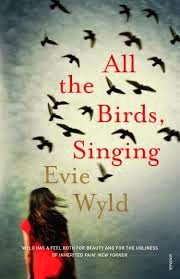
Congratulations to Evie Wyld, 2014 Miles Franklin award winner for 
All the birds, singing
 

The story starts with Jake Whyte, a tough as guts female Australian sheep farmer on a remote British island battling the elements with her dog, called Dog. She has a small flock of sheep and through them we discover that her tough exterior has a fragile, tender centre. Every now and then, one of the sheep is brutally killed and it disturbs Jake, perhaps more than it would most tough sheep farmers. What is out there in the foreign British woods that could do a thing like that to a sheep? A fox? A man? One of those wild cats escaped from a zoo that some people insist they see from time to time? Jake sees all of this as a threat to her solitude which is the only thing more important to her than her sheep and her dog.

The alternate chapters in the book follow another much younger woman, cutting her teeth on a sheep farm in remote Australia. She is the only woman amongst some very hardened men. She is a guarded and tense young woman but finds comfort in Greg, a fellow shearer. We follow her story backwards in time, which can be a little confusing but is a revelation in story writing when the reader adapts to Wyld's cadence. When Clare, an older man on the sheep farm, discovers her secret past everything is destined to unravel. We are driven even further back in time to the girl's past; a haunting Hitchcockian nightmare steeped in the colour of violent Australian masculinity and mateship.

With a spinning sense of geography and place - so Australian and yet so foreign - Wyld navigates themes of sexuality, displacement, resilience and even redemption. Although far from home Jake never lets go of the mirror that holds Australia in its reflection. This novel is a brooding comment on many contemporary themes but intelligently and subtly written to allow the story to hold.


Monday, June 23, 2014

Book review - The death of bees


The death of bees by  Lisa O'Donnell.

An unusual coming of age story about love, death and how to decide if someone will make a good friend.  Marnie and her little sister discover that their drug addicted parents have died.  One of an overdose, the other in heartbroken suicide.  Of course, instead of telling anyone they keep the secret to themselves and continue on.  They have been fending for themselves for a long time, can't they just keep doing that?  Marnie is a grown up teenager who longs to be a teenager and have fun, go out all night and let her hair down.  Her sister, Nelly, is a good girl but a little odd.  At least they have each other.

But, maybe not for long.  Lennie, the funny  man next door feels badly for the girls.  Always left alone by their parents, never properly cared for.  He can't help but step in and make sure the girls are fed and clothed properly.  They are all getting along just fine in this new family but will it all come crashing down?

Told in first person by the three main characters, this book is sad, funny and thoughtful, all at the same time.  These characters will fill your heart long after you have finished reading.

Sunday, June 15, 2014

Book review - Glow by Ned Beauman


A hip, modern thriller with an unlikely hero and a conspiracy fetish, Glow is the latest work from Granta prize winner Ned Beauman.  It centres on Raf, a young Londoner with a strange sleep disorder and a passion for trying new drugs.  Raf meets Cherish, a beautiful Burmese girl and becomes entwined in her complicated story.  A powerful multinational mining company, the strange behaviour of foxes and silent white vans abducting people off the streets all point to something very wrong going on in London.  Glow is a conspiracy thriller meets drug story meets romance - reinvented for a new generation.

The quick moving plot is deftly handled but it is Beauman's killer writing style that wins again in Glow.  He is sharp, intelligent but also witty and playful, never taking anything too seriously.

Ned Beauman is just 29 years old, lives in London and Glow is his third novel.  His book The teleportation accident was shortlisted for the Man Booker award and he has been named one of Granta's Best of Young British Novelists.


Monday, July 15, 2013

Book review - Last of the Vostyachs

Last of the vostyachs by Diego Marani

This is a short book best read in one sitting by the fire on a cold afternoon with a lovely cup of tea. Well, that's how I did it anyway.

Ivan is the last of his tribe. His father died in his arms in a Russian slave camp which Ivan manages to escape. The problem is that he has no idea where he is, where he should go or what he should do. His people were ancient shamans and Ivan feels a desperate need to return to his true life but that seems to have closed on him. Most importantly for the story, he is last person on earth to speak his language. He is a relic of an age that has made way for modernity and cultural assimilation.

Olga, a young ambitious academic linguist 'discovers Ivan. She learns his language and believes that it is a very old language and that more controversially, it is related to Finnish. Finnish itself if not related to other languages apart from Hungarian and Estonian. Ivan's language creates a bridge between Finnish and Inuit-Olet languages. Deigo writes his love of lanuages in detail and is sometimes a bit hard to understand but you do understand the concept here. The controversy is that most academics believe that Finnish is somehow pure. However, Ivan's existence suggests that is related to languages in the North American region.

In Olga's excitement she tell Jaarmo, her fellow linguist colleague who is now a professor. If you like characters you love to hate, then Jaarmo is for you. He is a self-important academic who now sees that his theories of language origin will be seriously in doubt. He cheats mercilessly on his wife who is going through something of a midlife crisis taking her anger for Jaarmo out on the dog he left behind. Olga's mistake is to trust Jaarmo. This sets in motion some disastrous events which will leave several people dead and Ivan's future in serious doubt.

The book is sad and beautiful at the same time. Ivan is wild and terrifying but simultaneously tender and endearing. There is a spark of humour that emerges only occasionally but when it does it is surprising and shines out in this somewhat sobering story.

Thursday, January 26, 2012

2011 the year of the great Australian Book?

By Claire at Kew Library.
Did you, last year, like me, often look up from your reading to think: what a great book - and it's Australian? Like me did you cry at Rory's funeral in Kylie Ladd's Last Summer ? (This book has been likened to Christos Tsiolkas' The Slap - only with people you actually like) Who were you cheering for in Derek Hansen's a Man You can Bank On? Were you carried away by Caroline Overington's I came to say goodbye? Did you hope against hope that Harry in Favel Pavretti's Past the Shallows would survive his brutish father? From the hilarious Aunts up the Cross by Robyn Dalton to the stirring Worse things happen at sea: tales of life, love, family and the everyday beauty in between by William McInnes and Sarah Watts, published just before Watts' death from cancer, it has been a moving, touching, funny and adventurous year.

Or did you miss this bumper year in Australian books? Never mind, because the great thing about books is that they can still be borrowed this year. They live on the library shelves, calling out "borrow me! Read me!" So this Australia Day - well not on the actual day, as we will be closed for the celebration- get out of the heat and head into your local library branch to make the most of Australian writing .

I started the year with Jasper Jones by Craig Silvey, Australia's answer to To kill a Mockingbird. It recalled small town adolescence, and I particularly loved the conversations between Charlie and Jeffrey. Having lived in a small country town myself I knew the joys and the prejudices that lurk in the shadows of people's good intentions. These things could have easily happened where I grew up; although I'm sure most locals would deny it. A bit more fanciful was Ed in Marcus Zusak's The messenger, the local ne'er-do-well righting the wrongs of his small town. As he slobbed around his share house with his equally unmotivated mates I was reminded of the young blokes I knew in my 20s. And the coming of age novel of Me and Mr Booker by Cory Taylor certainly didn't reflect my youth, but it reminded me of the teenage angst. The past really is another country.

And speaking of other countries, one of the great attributes of Australians is that they like to travel. I delighted in the adventures of Jane Paech and her family in A family in Paris: stories of food, life and adventure, more than I can every describe in words. If the story wasn't enough, the photos had me wanting to buy a ticket to Paris on the next plane (although I won't be enrolling my child in a French school anytime soon). Wanting to one day walking the pilgrimage Santiago de Compostela, I read both The year we seized the day: a true story of friendship, fury and sore feet (Elizabeth Best and Colin Bowles) although I confess Elizabeth annoyed me with her cavalier attitude toward her stress fractures and her on-going inner turmoils (relax woman, it's not all about you) - perhaps I am getting a bit old? Much more soothing was A food lover's pilgrimage to Santiago de Compostela by Dee Nolan. The photos were as sumptuous as the food. When on a driving holiday to NSW we popped the audio book From Here to There written and read by Jack and John Faine into the CD player. Whilst we weren't driving as far as them it was perfect company on our not quite so long drive, and was also suitable listening for our six year old. And finally for the most eccentric mode of travel, Going postal: the ups and downs of travelling the world on a postie bike by Nathan Millward was a delightful read. Sometimes you can't worry about whether you have all the right equipment and if the time is right. Sometimes you just have to have faith and just go.

But not all the travel was one way - The happiest refugee by Anh Do recounted the journey coming the other way. Other personal stories included Cooking with Baz : how I got to know my father by the birdman himself, Sean Dooley, where he describes looking after his father as he is dying of cancer; Lessons in letting go : confessions of a hoarder by Corinne Grant, and Unbearable lightness : a story of loss and gain by Portia De Rossi. I laughed at The 700 habits of highly ineffective parents by Jonathan Biggins, commiserated with Fifteen percent pregnant : a man, a woman and IVF by Tony Hardy, was inspired to get out and dig with the Kitchen gardens of Australia : eighteen productive gardens for inspiration and practical advice by Kate Herd. Susanna de Vries excelled again with The complete book of heroic Australian women: twenty-one extraordinary women whose stories changed history; she really is the grand dame of Australian women's history.

Australian writing at the moment is as varied, complex, multifaceted as those who make up the population in our wide brown land. There is much joy in the lack of stereotypical-ness, much delight in its originality. From the bush in Our houseless home : a colourful bush childhood during the great depression by Lyle Courtney to the small holding in Tasmania in Four seasons with a grumpy goat by Carol Altmann, to the suburbs in the The Bogan Delusion by David Nichols, every corner of our nation is covered.

Finally, honourable mentions for great fiction reads are: Bereft by Chris Wormsley; Book of lost threads by Tess Evans; Ghost Child by Caroline Overington; At home with the Templetons by Monica Mcinerney (why did I ever think she was Irish?); Six impossible things by Fiona Wood and Fall girl byToni Jordan (although I liked Addition better - really loved it actually - this was still a good read). There should be more dancing by Rosalie Ham was a humorous look at old age, but Last Chance Cafe by Liz Byrski was a celebration of it.

Phew I'm exhausted! What a huge collection of books - and I didn't include all the cookbooks. I think I'd better have a good lie down and a bit of a read but I can't choose between Jane Caro's Just a girl. Or Housewife superstar: the very best of Marjorie Bligh. Decisions, decisions, decisions.

Happy Australia Day!

Wednesday, January 18, 2012

Book review - Sacred Hearts, by Sarah Dunant

How do you choose what to read next? Some titles jump off the shelf, don't they? Others are recommended. Then there are those worthy books you feel you really must read. But, after that, how do you actually choose from all the thousands of titles out there?

When you are a librarian the pressure is worse. We advise others on their choice of reading material. To this end, we read reviews, listen to author interviews, and attend festivals, keeping our ears to the polished linoleum of the publishing world.

Here at City of Boroondara, we have another secret weapon and here today, I am going to reveal it to you.

It's called shelving time.

If you are a regular user of this library service, you will have noticed that our staff shelve for forty five minutes twice a day. If you have been around for a quite a while, you may have seen one of us, a book open, eyes focussed, our black shelving trolley all but forgotten. This is the power of shelving time. If you stick around long enough, you will notice some of those books don't get shelved. They stay on our trolleys. At the end of the day, they are carried out of the door in bulging library bags.

This is how I found Sacred Hearts, by Sarah Dunant.  I had read reviews and interviews about Dunant's work. I knew she was an international best-selling author of historical fiction, my favourite genre, that her work was experimental in its treatment of time and space - and edgy in its use of multiple plots and viewpoints. But for some reason, I had never got round to reading any of it.

Until recently.

I am not sure what drew my eye this time. The Nun on the cover, perhaps? I'll be confess, I have a weakness for convent books. To my mind, they fall into the same category as the boarding school books, I read as a child. I always wanted to go to boarding school - I blame Enid Blyton for that entirely. And though I have never had any desire to be a nun, there is also something about the cloistered world that holds a fascination for me. 

I opened the cover and read the historical note:
'By the second half of the sixteenth century, the price of wedding dowries had risen so sharply within Catholic Europe that most noble families could not afford to marry off more than one daughter. The remaining young women were dispatched - for a much lesser price - into convents. Historians estimate that in the great towns and city states of Italy, up to half of all noble women became nuns.
'Not all of them went willingly ...

Okay, she had me. A convent, a young woman ripped from an illicit love affair, a scholarly nun who runs a dispensary (shades of Brother Cadfael). I decided to give it a try. Here is how it starts:  those few paragraphs, you can see some of the major themes emerging - motherhood, sexuality, genius, suffering and the political manoeuvrings of the counter-reformation church. Once I started Sacred Hearts, it was difficult to it down. The characters were likeable, the situation credible, and the outcome although maybe not completely realistic, was very satisfying. I will be keeping an eye out for Sarah Dunant's other books during shelving time.
Written by Liz Corbett.